statcounter code

Showing posts with label wooden. Show all posts

Friday, November 14, 2014

Glossary of Shipbuilding Terms Explains the Jargon

It's Important for Model Shipbuilders to Understand


The Language of Shipbuilding


Glossary of Shipbuilding Terms Explains the Arcane


Glossary of Shipbuilding Terms
Whether you are just starting in the hobby of model shipbuilding or are an old pro, there are times when you will find mysteriously arcane terminology that traditional dictionaries don't define.
Our Glossary of Shipbuilding Terms comes from Charles G. Davis's The Building of a Wooden Ship (1917) which was written to familiarize carpenters and cabinetmakers with the art of shipbuilding.

We've added illustrations from a number of period sources and comments to help with comprehension of these terms, many of which have few, if any, modern equivalents.

TMS_ad_wooden_ship

Saturday, June 21, 2014

Free Ship Plans of Italaian Brigantine Schooner Gigino

Italian Brigantine Schooner Gigino

Demonstrates Pinnacle of Sailing Ship Design

What Chapelle would term "Hermaphrodite Brig"


free ship plans, sailing, vessels, brigantine, schooner, Italian 20th century, Gigino
20th Century Italian Brigantine Schooner Gigino
As steam powered ships threatened to finally replace sail for ocean-going cargo vessels, this pressure led naval architects to the pinnacle of their design skills. The final sailing ships balanced capacity with fine lines that allowed greater speed while carrying the maximum amount of cargo.

Another major design change was the change from square sail rigs to fore-and-aft sails. These schooner rigs required fewer sailors to handle the ropes, allowing sailing ships to remain financially competitive with the smaller crews of steam ships. The "brigantine schooner" - or "hermaphrodite brig," as American historian Howard I. Chapelle would name it - combined the two sail rigs with square sails on the forward mast and fore-and-aft sails on the main mast, giving it positive benefits of both sail types. These sailing ships remained competitive with steamships well into the 20th Century.

Our free ship plans of Italian brigantine Gigino offer a large body plan with ships' curves, as well as a detailed framing plan, section plan, keel and deadwood plan, and sail and rigging plan.

ad_souvenirs

Monday, January 20, 2014

Building Midwest Products' Chesapeake Bay Flattie Model Ship Kit

Midwest Products' Chesapeake Bay Flattie

Plank-on-Bulkhead Model Ship Kit

Promises Ease of Construction


plank-on-bulkhead model ship kit Chesapeake Bay Flattie
Midwest Products Chesapeake Bay Flattie kit.
While solid-hull ship models are generally considered the easiest to construct, Midwest Products has created a "Success Series" of ship model kits that offer plank-on-bulkhead models that promise to make model shipbuilding easy for the complete novice.

We decided to test this theory by making Midwest's Chesapeake Bay Flattie ship model kit our first on-line kit build. The simple lines of these boats that made them ideal for locals to build from locally-available lumber should also make this an ideal ship model kit or a person with no prior wood ship model building experience.

The biggest challenge of plank-on-bulkhead ship models is planking the hull, and because of the simple shape of these boats, this task is accomplished in this kit with a single plank on each of the sides, and two planks on the bottom.

The kit comes with well-executed die-cut and pre-cut parts, as well as fittings, rigging line, sail material, and a well-done set of instructions and building plans.

Click on the links below to visit each stage of construction:
Chesapeake Bay Flattie Kit: Introduction
Chesapeake Bay Flattie Kit: Chapter 1, Keel and Bulkhead assembly
Chesapeake Bay Flattie Kit: Chapter 2, Deck Assembly
Chesapeake Bay Flattie Kit: Chapter 3, Mast Steps and Bow Stiffeners

We have a lot more steps ahead of us, so keep checking back for updates!

ad_souvenirs

Wednesday, April 3, 2013

Free Plans of Historic Lumber Schooner Wawona

A Subject for a Historic Ship Model


Wawona one of only two lumber schooners still preserved


Free plans of the West Coast lumber schooner Wawona for a scratch-built ship model
Lumber Schooner Wawona
Scores of wooden three-masted schooners once plied the Pacific Ocean off the U.S. West Coast, bringing lumber from the Pacific Northwest to the growing cities of California. Two of them are all that remain of this vast fleet. Built in the 1897 for Dolbeer & Carson Lumber Company of Eureka, California,   the schooner Wawona is one of the two known to be preserved. She and the other surviving lumber schooner, C.A. Thayer (National Maritime Museum, San Francisco), were built by Hans D. Bendixsen, who was well known in his time for the superior construction of his vessels.

Able to transport more than 500,000 board feet of lumber per voyage, like most ships in her day, Wawona’s hull was lofted from a carved wooden half model rather than a detailed set of engineering drawings. The free ships plans offered here are from a 1986 survey in preparation for a $2 million restoration.

Friday, March 22, 2013

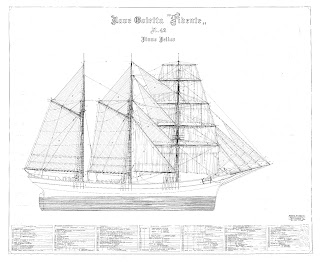
Free Plans of 19th Century Italian Barquentine "Fidente"

free ship plan 19th century Italian barquentine Fidente ship-schooner
Italian "Ship-Schooner" Fidente

From Italian archives come the plans of the “Ship-Schooner” Fidente (Trusting).
In English we would refer to her as a barquentine (alternatively barkentine), which wikipedia defines as "a sailing vessel with three or more masts; with a square rigged foremast and fore-and-aft rigged main, mizzen and any other masts."
I've found a few historical reference to European emigrants arriving in the U.S. aboard a "brig" named Fidente, which as sail-rig terminology can be somewhat loose depending on the person writing it, but nothing solid on her history. If you can track down any more info, please let us know via our contact page.
Even without further documentation, I think Fidente would make a handsome ship model, and would be a good subject if you're not quite ready for a full-rigged ship model.

Sunday, February 3, 2013

Free Ship Plan: French Warship Montebello

free, ship, plan, French, ship, warship, Montebello
French warship Montebello in 1850
Launched in 1812, Montebello was an OcĂ©an type ship of the line of the French Navy. Plans list her as a 120-gun ship, but many historical references refer to her as a 118-gun ship. She had an impressive 77-year career in the French navy. 

We have a massive collection of 10 high resolution plans of Montebello on our website, including lines, inboard and outboard profile, deck, rigging, mast, and sail plans. We even have accommodations plans showing how stores were shipped aboard this historic warship.

For the model shipwright looking for a massive project, the French ship-of-the-line Montebello may be just what you are looking for.

Monday, January 28, 2013

Free Ship Plan: Gokstad Viking Longboat

viking, longship, gokstad, long, ship, plan, drawing, free, Norway
Plan of Gokstad Viking Longship from Ancient and Modern Ships

For generations, the sight of a Viking longship sail on the horizon sent chills of fear down the spines of Medieval Europeans. However, Viking longships were used by Scandinavian mariners for everything from commerce to exploration in addition to warfare. Vikings used them to discover new lands to settle in Iceland and Greenland, and it appears they reached the shores of North America hundreds of years before Christopher Columbus.

Our Viking longship plan comes from Ancient and Modern Ships by Sir George Charles Vincent Holmes, published in 1906. Holmes Took from Transactions of the Institution of Naval Architects, Vol. xxii, from a paper by noted naval architect Colin Archer. This particular smaller Viking longship was discovered in 1880 in a grave at Gokstad near Sandefjord at the entrance of the Fjord of Christiana. Built entirely of oak, she was 77 ft. 11 inches in length, extreme breadth 16 ft. 7 inches, depth from top of keel to gunwale 5 ft 9 inches.


Friday, December 28, 2012

Free Ship Plan: Ancient Trireme

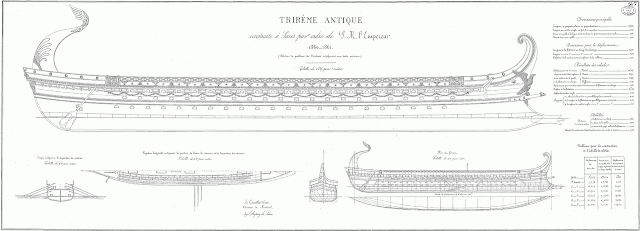
While looking through the French Atlas of Marine Engineering I stumbled across this really cool plan for a trireme, the ancient rowed battleships of Greek and Roman empires. This would make a really cool ship model with a tiny bronze ram at the bow and a gazillion oars protruding from the sides.
Free, ship, plan, trireme, row, oar, Mediterranean, Sea, Roman, Greek, Byzantine
Trireme oar-powered battleship of the ancient Mediterranean Sea

Monday, December 24, 2012

Free Ship Plan: 77-foot North River Schooner

Another interesting free ship plan from Wooden Ship Building by Charles Desmond is the North River Schooner.  The plans are a little rough, as the pages are yellowed and the ink faded, but the missing bulwark lines can be recreated using a coffee stir as a batten. Hold it on edge and bend it to match the existing lines on either side of the missing portion. The wood will give you an accurate curve to trace with a pencil to fill in where the lines are too faint to see.
free ship plan, sail, schooner, New England, Hudson River, North River, vessel
Sail Plan for a 77 foot North River Schooner
free ship plan,section, waterline, sheer, lines, schooner, New England, Hudson River, North River, vessel
Section, Sheer, and Waterline Plans of North River Schooner

This 77-footer is typical of the shoal draft centerboard sailboats used on the Hudson River to haul bulk cargo in the  19th Century. When it was extended, the centerboard acted as a keel, giving the boat stability when tacking to windward, keeping it from "crabbing" - moving sideways rather than forward. When retracted, it allowed the boat to get into shallow waters common along the river, or even be beached for unloading where a harbor wharf wasn't available.

From The Sloops of the Hudson, by By William E. Verplanck and Moses W. Collyer (The Knickerbocker Press 1908):


 The North River schooner was built on somewhat the same plan as the sloop, having a center board, and her bowsprit carried out almost horizontal, and one head-sail, the single jib, attached to a jib-boom, as with the sloop.* (A few of the later schooners carried a flying-jib.---W.E.V.)  She carried not foretopmast. The skippers contented themselves with a maintopsail only and set it like the sloop’s. The foresail was of good size compared with the mainsail and not a mere “ribbon” such as the racing schooner yacht now carries.  The quarter-deck was replaced in the later schooners by a trunk cabin, lighted from the side and end, affording smaller and less pleasant accommodations than those below the quarter-decks of the old packet sloops with their large windows for light and air at the stern.

The schooners were not as good in windward work as the sloop, but with a fair or beam wind they were faster.  The rig, however, soon commended itself for the sloop with her long boom, tall mast, and heavy mainsail was difficult to handle at all times and especially in a blow and required a crew of six men to the schooner’s four. The first of the schooners were converted sloops. From which many of the larger ones were changes to save expense of operation. Late, about 1865 there was built  a new type of schooner for the Hudson which though rigged the same was a wider and shallower boat thus giving her greater carrying capacity and permitting all the cargo to be placed on deck for expedition in loading and unloading. She was quite sharp forward, which—with other good points in her model—made her good sailer.


Wednesday, December 12, 2012

Scarf Joints: Essential in Shipbuilding


In building full-size wooden ships, it is impossible to get wood timbers long enough to make some of the structural members. In these cases, several pieces are joined together lengthwise by "scarfing": tapering the ends, lapping them and then fastening the two together.

shipbuilding, construction, ship, wooden, wood, scarph, joint, model
Types of Scarphs - illustration from
The Construction of a Wooden Ship
by Charles G. Davis
As Charles G. Davis notes in his book The Building of a Wooden Ship:

Scarfing timbers together is one of the most important processes in wooden shipbuilding and deserves detailed explanation.
The length of the scarf is shown in the plans or specifications and is usually given to the workmen by the foreman who lays out the work. The foreman also tells the workmen the depth to make the pointed end or nib, as it is called, but if he does not, 23 percent, or about one-fifth the depth of the timber, is a safe rule to cut to.
Care must be taken not to run the saw out any deeper so as to make a weak spot where the timber may split when bent. The scarf is first marked out on the timber and is then sawed out on a band saw or circular saw. If neither is available a 5-foot or 6-foot cross-cut saw may be used and several saw cuts made and the chunks of wood spilt, chopped, or dubbed out with a broadaxe. The timber is then trimmed or dubbed off. carefully to the line on the face or working side of the timber with an adz. The remaining wood is then worked off, using the carpenter's square frequently to see that too much is not cut away. The face of the scarf is finished off with a plane so that the carpenter^s square fits perfectly on its face when applied at various points across it.
There are several kinds of scarfs; the plain scarf, flat scarf, hook scarf, lock scarf, etc. The plain and flat scarf are the ones most commonly used and the hook scarf comes next. The lock scarf has an opening in which is driven an oak wedge or key for the purpose of keying and setting the ends of the scarf tightly together. The keel scarf with tenons is a combination of the plain and hook scarf and is more difficult to cut and fit. To prevent pulling apart short wooden pins, called dowels, fitted vertically in the face of the scarf, were formerly used, but nowadays the more common practice is to bore across at the seam where the two faces meet and drive in treenails, long wooden pins about the size and shape of broom handles and usually made of locust wood. Sometimes a better fit can be obtained by running a cross-cut saw through the joint. When the surfaces fit perfectly with their nibs or ends pushed tightly together by means of a jack at one end, they are either clamped together with big iron screw clamps or are wrapped with chains with wedges driven between the chains and the timber so as to draw the wood tightly together.
Vertical holes are bored and iron or steel clinched fastenings and treenails are driven by the use of compressed air tools — air drills and air hammers. In some yards electric drills are used. Where air or electric tools are not provided the holes are bored with hand augers and the dowels and treenails are driven by sledge hammers. 

These strong joints are also useful in model ships, so it is a good idea to learn how to create them in miniature.

Saturday, December 8, 2012

New Illustrations on the Shipbuilding Terms Pages

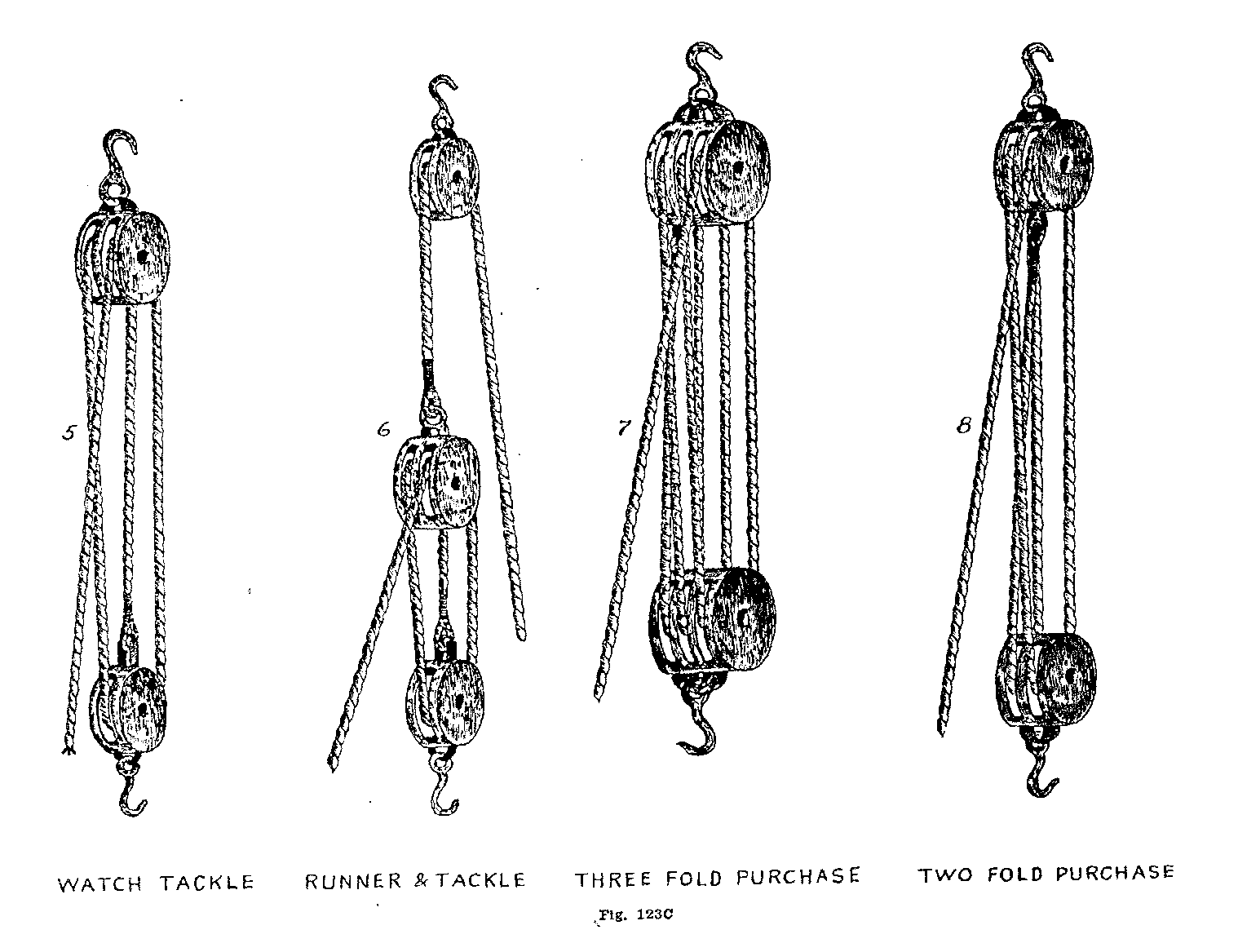
We've added some great illustrations of blocks and tackle from Wooden Ship Building by Charles Desmond to the Shipbuilding Terms pages:
sheave, block, tackle, ship, rigging, purchase, shipbuilding, ship building, terms
Types of Sheaves and Blocks Illustration from Wooden Ship Building by Charles Desmond
sheave, block, tackle, ship, rigging, purchase, shipbuilding, ship building, terms
Types of Tackle Illustration from Wooden Ship Building by Charles Desmond


sheave, block, tackle, ship, rigging, purchase, shipbuilding, ship building, terms
Types of Tackle Illustration from Wooden Ship Building by Charles Desmond

Wednesday, December 5, 2012

Free Ship Plan 19th Century Steam Fishing Trawler


Free ship plan, steam-powered, fishing, trawler, W.E. Redway, Canada, Great Lakes
Steam-powered 19th Century fishing trawler designed by W.E. Redway
These plans, from the University of Washington Freshwater and Marine Image Bank, are of a late 19th Century steam-powered auxiliary fishing trawler of about 80 feet in length, designed by W.E. Redway.

Free ship plan, steam-powered, fishing, trawler, W.E. Redway, Canada, Great Lakes, deck plan
Deck and inboard profile view of 19th Century Great Lakes
steam-powered fishing trawler designed by W.E. Redway
W. E. Redway was a Great Lakes shipbuilder in the late 1800s. 

Born in England, his father was also a shipbuilder. Redway served an apprenticeship in the Chatam dock yard in England, followed by positions in various shipyards "on the northeast coast of England and on the (River) Clyde," according to an 1897 profile in The Globe newspaper in Toronto. The River Clyde, flowing through Scotland's industrial city of Glasgow, was a major shipbuilding center during the Industrial Revolution.

Redway moved to Toronto, Canada in 1886.

Free ship plan, body, sheer, waterline, plan, 19th Century, Great Lakes, Canada, steam-powered, fishing, trawler
Body, Sheer, and waterline plans of 19th Century Great Lakes
steam-powered fishing trawler designed by W.E. Redway
According to The Globe newspaper profile, Redway "up to June 1897, planned and constructed eleven steam vessels. These were the Imperial, the Mayflower, the Primrose, the Garden City, the Mascotte, the Mistassini, the Medora and others. He also framed the Gooderham yachts Cleopatra and Oriole. Hearing of some of his good work, the managers of the Union shipyards at Buffalo sent for Mr. Redway, and he was there second in charge of the building of the steamer Ramapo, being occupied for six months of the year of 1895 at that work."

Tuesday, December 4, 2012

Our Favorite Model Shipbuilding Book

One of the best all-around ship model building books for those contemplating building from scratch, Charles G. Davis' The Shipmodel Builder's Assistant also has tons of useful info ship model kit builders can use to improve their result.

Sunday, October 7, 2012

New Page: "The Hull: Heart of a Wooden Ship"

Once you've read our page "How to Read a Ship Plan,"  move on to our new page "The Hull: Heart of a Wooden Ship."

free ship plan, sailing, vessel, fishing, schooner, downloadable, Lettie G. Howard, wooden, boat
Fishing schooner Lettie G. Howard lines plan, courtesy Library of Congress
In it we describe all the major components that make up a prototype ship's hull, from keel to deck beams, and explain their function. 

We also provide a bunch of free ship plans for New England fishing schooners Ernestina and Lettie G. Howard pulled from the collection of the Library of Congress.