statcounter code

Showing posts with label maritime history. Show all posts

Friday, November 14, 2014

Glossary of Shipbuilding Terms Explains the Jargon

It's Important for Model Shipbuilders to Understand


The Language of Shipbuilding


Glossary of Shipbuilding Terms Explains the Arcane


Glossary of Shipbuilding Terms
Whether you are just starting in the hobby of model shipbuilding or are an old pro, there are times when you will find mysteriously arcane terminology that traditional dictionaries don't define.
Our Glossary of Shipbuilding Terms comes from Charles G. Davis's The Building of a Wooden Ship (1917) which was written to familiarize carpenters and cabinetmakers with the art of shipbuilding.

We've added illustrations from a number of period sources and comments to help with comprehension of these terms, many of which have few, if any, modern equivalents.

TMS_ad_wooden_ship

Monday, August 19, 2013

Free Ship Plans Liberty Ship Arthur M. Huddell

Plans Classic World War II Cargo Ship

Liberty Ship Arthur M. Huddell

One of just three Liberty Ships left

Liberty Ship Arthur M. Huddell
We have ship plans for Arthur M. Huddell, one of three remaining Liberty Ships, of which the U.S. Maritime Commission ordered more than 2,700 during World War II. She was classified as EC2-S-C1.
These standard-design, mass-produced general-purpose cargo ships were the workhorses of World War II. Libery ships were part of the U.S. Maritime Commission’s “Emergency Program” launched when the United States entered World War II. The massive ship construction plan utilized new and existing shipyards across the United States to build ships of standardized design from prefabricated parts, greatly reducing construction time.

Tuesday, August 13, 2013

New book on work of François-Edmond Pâris

Selected Plates from Souvenirs de Marine


Souvenirs de Marine François-Edmond Pâris, French, navy, admiral, Francois-Edmund Paris, ship plans
New book available soon!
Update: Our book on the work of François-Edmond Pâris, "Selected Plates from Souvenirs de Marine" is now available! Our book contains more than 90 plates from Souvenirs de marine. Collection de plans ou dessins de navires et de bateaux anciens ou modernes existants ou disparus avec les éléments numériques nécessaores à leur construction.

More than 130 ship plans are included ranging from ancient vessels to late 19th Century. There are warships, merchant vessels, fishing vessels, and small craft from Europe, Asia, Africa, and the U.S. The plates are indexed by plate number, illustrated vessel type, named vessel, and by country/region.

The book also includes an appendix "How to Read a Ship Plan" to help the novice understand the lines used to illustrate in two dimensions the shape of a three-dimensional ship.

The book is available now on Kindle and should be available on Amazon sites worldwide within a week.

Tuesday, August 6, 2013

Free Ship Plans USS San Marcos, later Spanish Navy ship Galica

USS San Marcos, Landing Ship Dock, anchored next to USS Donner.U.S. Navy Photo
Launched too late for World War II action, Casa Grande-class Landing Ship Dock USS San Marcos had long history nevertheless. After a 26-year career in the U.S. Navy, she went on to end her career as Spanish Navy ship Galica, where she served until 1988.
USS San Marcos (LSD-25) was a Casa Grande-class Landing Ship – Dock of the United States Navy, named for the Castillo de San Marcos, the oldest masonry fort still standing in the United States.
An unusual subject, these free ship plans of USS San Marcos would be a great project for a ship model builder interested in either warships or cargo ships.

Wednesday, April 3, 2013

Free Plans of Historic Lumber Schooner Wawona

A Subject for a Historic Ship Model


Wawona one of only two lumber schooners still preserved


Free plans of the West Coast lumber schooner Wawona for a scratch-built ship model
Lumber Schooner Wawona
Scores of wooden three-masted schooners once plied the Pacific Ocean off the U.S. West Coast, bringing lumber from the Pacific Northwest to the growing cities of California. Two of them are all that remain of this vast fleet. Built in the 1897 for Dolbeer & Carson Lumber Company of Eureka, California,   the schooner Wawona is one of the two known to be preserved. She and the other surviving lumber schooner, C.A. Thayer (National Maritime Museum, San Francisco), were built by Hans D. Bendixsen, who was well known in his time for the superior construction of his vessels.

Able to transport more than 500,000 board feet of lumber per voyage, like most ships in her day, Wawona’s hull was lofted from a carved wooden half model rather than a detailed set of engineering drawings. The free ships plans offered here are from a 1986 survey in preparation for a $2 million restoration.

Friday, March 22, 2013

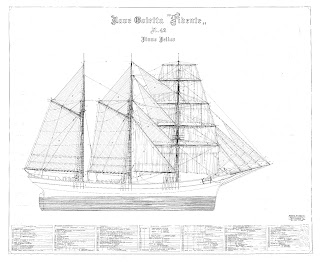
Free Plans of 19th Century Italian Barquentine "Fidente"

free ship plan 19th century Italian barquentine Fidente ship-schooner
Italian "Ship-Schooner" Fidente

From Italian archives come the plans of the “Ship-Schooner” Fidente (Trusting).
In English we would refer to her as a barquentine (alternatively barkentine), which wikipedia defines as "a sailing vessel with three or more masts; with a square rigged foremast and fore-and-aft rigged main, mizzen and any other masts."
I've found a few historical reference to European emigrants arriving in the U.S. aboard a "brig" named Fidente, which as sail-rig terminology can be somewhat loose depending on the person writing it, but nothing solid on her history. If you can track down any more info, please let us know via our contact page.
Even without further documentation, I think Fidente would make a handsome ship model, and would be a good subject if you're not quite ready for a full-rigged ship model.

Monday, March 11, 2013

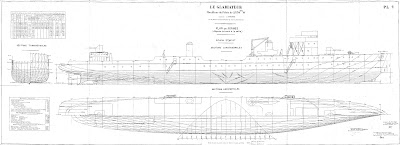
French 20th Century Warship Le Gladiateur

free ship plan French 20th Century Warship Le Gladiateur The Gladiator net-laying anti-submarine warfare
Le Gladiateur 1933
For those of you who enjoy 20th Century warships, here's an interesting project for a ship model builder: A French net-laying ship, Le Gladiateur, launched in 1933. She was scuttled at Toulon  in 1942 by her own crew to avoid capture. She was salvaged the following year by Italians, then captured by Germans and commissioned into the Kriegsmarine in January 1944 as SG18. She was bombed and sunk by Allied aircraft in 1944.
Due to her relatively small size (compared to a battleship) she could be built at a larger scale and still create a ship model of manageable size. Our page on Le Gladiateur offers ships lines plans, outboard profiles, and deck plans: everything you need for scratch-building a highly-detailed ship model. We have more detailed plans available as well. For more information on those, please inquire on our Contact Page.

Saturday, February 23, 2013

Even More Oar-powered Free Ship Plans

Free ship plans of oar-powered vessels are our most popular offering on TheModelShipwright.com, so we've added even more.


free ship plan Paris Pâris Athenian Greek Trireme Souvenirs de Marine Conserves
Paris's Athenian Trireme
Thanks to the work of French Vice-Admiral François-Edmond Pâris and Swedish naval architect Fredrik Henrik af Chapman, we have some of the best plans of oar-powered galleys and triremes available.

Pâris's most famous work Souvenirs de Marine Conservés brings us plans for triremes from Athens and Venice as well as a Black Sea Galley. Chapman's Architectura Navalis Mercatoria brings us a Maltese galley and several others we have yet to post.


Free ship plan, galley of Malta, Chapman, Chapman's Architectura Navalis Mercatoria, oar-powered
Chapman's Maltese Galley
Along with the Atlas du Génie Maritime from the archives of the French Ministry of Defense, which brings us an Ancient Trireme, a Sultan's Caique, and an Ancient Galley, and our plan of the Gokstad Viking Longship from Ancient and Modern Ships by Sir George Charles Vincent Holmes, there is a lot to choose from at TheModelShipwright.com if you are looking for free ship plans of oar-powered vessels.

Saturday, February 16, 2013

Free Ship Plan: Steam Tug Hercules

free, ship, plan, historic, steam, tug, Hercules, boat, vessel, steel
Steam Tug Hercules
Recently, we've been concentrating on Oar-Powered Vessels and Sailing Vessels, so maybe it's time to come back to the 20th Century, and offer a free ship plan of a historic Motor Vessel.

Few motor vessels have more character or make a more handsome ship model than the steam-powered tug boat. As a model ship, these vessels offer a lot of appeal, especially for someone desiring a radio-controlled model. There are even working scale steam engines that can be built into a model tugboat for the ultimate in operating realism.
And what better choice for that ship model than a historic tug such as Hercules? The last remaining ocean-going steam tug on the West Coast, Hercules was designated a National Historic Landmark in 1986. She was was documented as part of the Historic American Engineering Record, a program of the National Park Service. We've brought together the photos and drawings from that survey on our Hercules Plan Page and Hercules Photo Gallery.

Sunday, February 10, 2013

Free Ship Plan: Schooner Musquidobit (Lynx?)

free, ship, plan, schooner, American, Musquidobit, Lynx, French, Military, Archive, Baltimore, clipper
American Schooner Plans from a French Military Archive

While searching for Medieval boats in the archives of a French library, I came across these plans for "American Schooner Musquidobit" and "Other American Schooner." 
By its lines, "Musquidobit" appears to be the Baltimore-built schooner Lynx, captured by the British and renamed when brought into the British navy. The French Ministry of Defense has a number of foreign craft documented in its archives - basically the work of spies keeping track of advances in naval architecture among France's colonial competitors.
The lower ship, just titled “Other American Schooner,” is very similar in lines, however it seems her lines are not as fine, the fullest point of beam carried further aft before she narrows to the transom. This should increase her displacement, and therefore, her cargo capacity.
I don't have time to research this further right now, so if anyone has info on these ships, feel free to contact us.

Friday, February 8, 2013

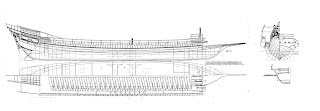
Free Ship Plan: La Couronne 17th Century French Warship


Maritime historians and model shipwrights owe a lot to French naval admiral François-Edmond Pâris. He published a number of books in the 19th Century that featured plans, drawings, and even beautiful watercolor paintings of vessels from around the world. He also documented historical ships no longer in existence, but previously recorded by others. La Couronne is an example of this.
free,ship,plan, 17th Century, French, warship, La Couronne, sailing, vessel, ship of the line
17th Century French Warship La Couronne
Ships plans for La Couronne, a 17th Century French first rate warship come from Pâris's Souvenirs de Marine Conservés, ou Collection de plans de navires de guerre et de commerce et de bateaux divers de tous les pays tracés par les constructeurs ou marins … recueillis et publiés par l’amiral Pâris.
La Couronne (French for “The Crown”) was commissioned into the French Navy in 1636. She was a war galleon built by the French as part of the effort by Cardinal-duc de Richelieu et de Fronsac, King Louis XIII’s chief minister, to ensure the French Navy was dominant on the seas.
Built 200 years before the 120-gun French ship of the line Montebello, in La Couronne one can really see the link between early Medieval vessels and the magnificent warships of the golden age of sail. Her massive castellated quarter decks recall the war galleys of the Mediterranean, on which bow and stern "castles" served as battle platforms from the Ancient to Medieval times.

Thursday, February 7, 2013

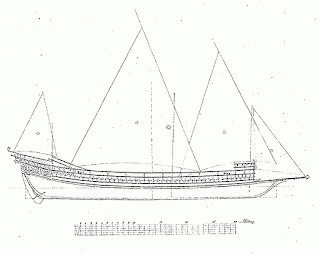
Free Ship Plan: Sultan's Caique

free, ship, plan, ottoman, sultan, caique, oar, powered, galley
Ottoman Sultan's Caique

Haven't had much time to research this oar-powered Ottoman imperial vessel, but from Wikipedia, we get:
 ... imperial caïques used by the Ottoman sultans and his suite for ceremonial and daily excursion purposes. The size and grandeur of this type, adorned with imperial armorials and floral scrolls, was a reflection of his royal power. Another feature of imperial caiques was the deck pavilion, a partition or a small kiosk for the Sultan. By reason of this feature they were also called the pavilion caïques.

Wednesday, February 6, 2013

Great Site for Ship Model Plans

A friend of ours in Turkey has a great website for model shipbuilders. He also offers a wide selection of  free ship plans, but where our ship plans are prototype ship plans than can be adopted to model shipbuilding, many of his plans show the ships already adapted to models. Many feature full-size patterns that can be used to cut the keel and bulkheads, and some even feature info on motor installation for radio-controlled operation. This provides a valuable shortcut if you are not familiar with completing this process with a prototype ship plan.

J M Briscoe - Clyde puffer VIC32 moored at Corpach by  Jmb at en.wikipedia
Our all-time favorite of his plans is the Lochinvar Clyde Puffer, a typical Scottish coastal vessel from the early 20th Century. These little tubs just radiate personality. They are so much a part of the U.K. maritime history that a series of novels were written about the exploits of a fictional crew, and later a BBC television series was made based on those books.

This ship is a great subject for modeling because, while the prototype is not very large, it has the very "salty" looks of much larger freighters. With a Clyde Puffer model you can build to a fairly large scale and still have a model that is easily handled.

Another factor that makes this ship a great subject for modelling is that a huge number of these were made during World War II. Classified as "VIC" Victualling Inshore Craft, after the war they were sold off for private use and some still can be found afloat. There are a vast number of images of them available through a simple internet search, so an infinite number of details can be used to make your Clyde Puffer model distinct.

Clyde Puffers also have a very simple, boxy hull shape that makes it easy to plank the hull with sheets of wood veneer, and offers an easy way to learn some of the basic skills that will be needed when it comes to planking more complex hull shapes.

Sunday, February 3, 2013

Free Ship Plan: French Warship Montebello

free, ship, plan, French, ship, warship, Montebello
French warship Montebello in 1850
Launched in 1812, Montebello was an Océan type ship of the line of the French Navy. Plans list her as a 120-gun ship, but many historical references refer to her as a 118-gun ship. She had an impressive 77-year career in the French navy. 

We have a massive collection of 10 high resolution plans of Montebello on our website, including lines, inboard and outboard profile, deck, rigging, mast, and sail plans. We even have accommodations plans showing how stores were shipped aboard this historic warship.

For the model shipwright looking for a massive project, the French ship-of-the-line Montebello may be just what you are looking for.

Saturday, February 2, 2013

Free Ship Plan: Ancient Galley

Due to the popularity of our free ship plan pages for the Ancient Trireme and the Gokstad Viking Longship, we've added a new oar-powered vessel plan.

free, ship, plan, ancient, galley, oar-powered, oars, sailing, wooden, vessel
Free Ship Plan of an Ancient Galley
This Ancient Galley plan is from the Atlas du Génie Maritime in the archives of the French Le Ministère de la Défense. This atlas of ship plans was created in the 19th Century, and features both contemporary and ancient ships.

My guess is this galley is not truly ancient, but probably no older than the Medieval period. I haven't translated most the plan, so it may have info on it to pin down its provenance. I did get as far as the title, which roughly translates to an "Ancient Galley of 36 Banks of Oars, Five Rowers per Bank."

With its three lateen sails and sides bristling with oars, this ship offers a chance for the model shipwright to screatch-build a unique ship model that would truly be an impressive display.

Thursday, January 31, 2013

Free Ship Plan: Lettie G. Howard


free, ship, plan, schooner, lettie g. howard, themodelshipwright.com
Lettie G. Howard  under sail, photo by Nelson Micheal Chin

free, ship, plan, fishing, schooner, lettie g. howard, fredonia
Lettie G. Howard sail plan
The last existing clipper-bowed inshore Fredonia model fishing schooner,  Lettie G. Howard was surveyed in 1989 for the Historic American Engineering Record (HAER), which documents historically significant engineering, industrial, and maritime works in the U.S. The project is administered by the National Park Service, U.S. Department of the Interior. The drawings and photos from that survey are maintained by the Library of Congress, and we offer them at TheModelShipwright.com:
Lettie G. Howard Plan Page
Lettie G. Howard Photo Gallery


Monday, January 28, 2013

Free Ship Plan: Gokstad Viking Longboat

viking, longship, gokstad, long, ship, plan, drawing, free, Norway
Plan of Gokstad Viking Longship from Ancient and Modern Ships

For generations, the sight of a Viking longship sail on the horizon sent chills of fear down the spines of Medieval Europeans. However, Viking longships were used by Scandinavian mariners for everything from commerce to exploration in addition to warfare. Vikings used them to discover new lands to settle in Iceland and Greenland, and it appears they reached the shores of North America hundreds of years before Christopher Columbus.

Our Viking longship plan comes from Ancient and Modern Ships by Sir George Charles Vincent Holmes, published in 1906. Holmes Took from Transactions of the Institution of Naval Architects, Vol. xxii, from a paper by noted naval architect Colin Archer. This particular smaller Viking longship was discovered in 1880 in a grave at Gokstad near Sandefjord at the entrance of the Fjord of Christiana. Built entirely of oak, she was 77 ft. 11 inches in length, extreme breadth 16 ft. 7 inches, depth from top of keel to gunwale 5 ft 9 inches.


Wednesday, January 9, 2013

Free Ship Plan: New York Pilot Schooner

Free, New York, pilot, schooner, ship, lines, plan, drawing, sailing, vessel
New York Pilot Schooner lines plan from Desmond's Wooden Ship Building
This New York Pilot Schooner is another plan from Desmond's Wooden Ship Building. These boats share a lot in common with the Baltimore Clipper Schooner in hull shape. Especially in the "drag" of the keel: The ship sits much deeper at the stern than at the bow. One way in which they differ from their ancestor is the bow is much more plumb. Baltimore Clippers tended to have the outward curving bow of a cutter.

This would work up into a nice ship model. Because of the fairly small size of the prototype New York Pilot Boats, model ships can be built to a fairly large scale without resulting in a model too big for display in the average home.

The fore-aft rig of the schooner also simplifies the task of rigging this model ship, but still provides a very salty-looking result. Scratch-building a model of this ship is a good way to develop model shipbuilding skills needed for a larger project, such as a tea clipper of ship of the line, and allows the model builder to see results much more quickly.

Friday, December 28, 2012

Free Ship Plan: Ancient Trireme

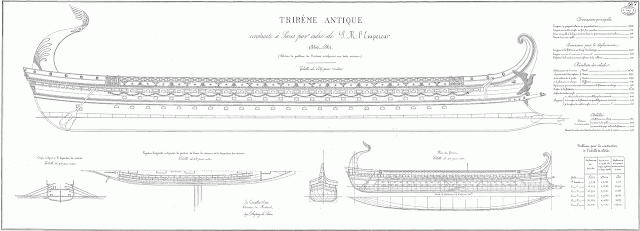
While looking through the French Atlas of Marine Engineering I stumbled across this really cool plan for a trireme, the ancient rowed battleships of Greek and Roman empires. This would make a really cool ship model with a tiny bronze ram at the bow and a gazillion oars protruding from the sides.
Free, ship, plan, trireme, row, oar, Mediterranean, Sea, Roman, Greek, Byzantine
Trireme oar-powered battleship of the ancient Mediterranean Sea

Monday, December 24, 2012

Free Ship Plan: 77-foot North River Schooner

Another interesting free ship plan from Wooden Ship Building by Charles Desmond is the North River Schooner.  The plans are a little rough, as the pages are yellowed and the ink faded, but the missing bulwark lines can be recreated using a coffee stir as a batten. Hold it on edge and bend it to match the existing lines on either side of the missing portion. The wood will give you an accurate curve to trace with a pencil to fill in where the lines are too faint to see.
free ship plan, sail, schooner, New England, Hudson River, North River, vessel
Sail Plan for a 77 foot North River Schooner
free ship plan,section, waterline, sheer, lines, schooner, New England, Hudson River, North River, vessel
Section, Sheer, and Waterline Plans of North River Schooner

This 77-footer is typical of the shoal draft centerboard sailboats used on the Hudson River to haul bulk cargo in the  19th Century. When it was extended, the centerboard acted as a keel, giving the boat stability when tacking to windward, keeping it from "crabbing" - moving sideways rather than forward. When retracted, it allowed the boat to get into shallow waters common along the river, or even be beached for unloading where a harbor wharf wasn't available.

From The Sloops of the Hudson, by By William E. Verplanck and Moses W. Collyer (The Knickerbocker Press 1908):


 The North River schooner was built on somewhat the same plan as the sloop, having a center board, and her bowsprit carried out almost horizontal, and one head-sail, the single jib, attached to a jib-boom, as with the sloop.* (A few of the later schooners carried a flying-jib.---W.E.V.)  She carried not foretopmast. The skippers contented themselves with a maintopsail only and set it like the sloop’s. The foresail was of good size compared with the mainsail and not a mere “ribbon” such as the racing schooner yacht now carries.  The quarter-deck was replaced in the later schooners by a trunk cabin, lighted from the side and end, affording smaller and less pleasant accommodations than those below the quarter-decks of the old packet sloops with their large windows for light and air at the stern.

The schooners were not as good in windward work as the sloop, but with a fair or beam wind they were faster.  The rig, however, soon commended itself for the sloop with her long boom, tall mast, and heavy mainsail was difficult to handle at all times and especially in a blow and required a crew of six men to the schooner’s four. The first of the schooners were converted sloops. From which many of the larger ones were changes to save expense of operation. Late, about 1865 there was built  a new type of schooner for the Hudson which though rigged the same was a wider and shallower boat thus giving her greater carrying capacity and permitting all the cargo to be placed on deck for expedition in loading and unloading. She was quite sharp forward, which—with other good points in her model—made her good sailer.