statcounter code

Showing posts with label cargo. Show all posts

Sunday, March 29, 2015

More Progress on Midwest Products' Chesapeake Bay Flattie Model Ship Kit

Midwest Products' Chesapeake Bay Flattie

Plank-on-Bulkhead Model Ship Kit

Promises Ease of Construction


plank-on-bulkhead model ship kit Chesapeake Bay Flattie
Midwest Products Chesapeake Bay Flattie kit.
While solid-hull ship models are generally considered the easiest to construct, Midwest Products has created a "Success Series" of ship model kits that offer plank-on-bulkhead models that promise to make model shipbuilding easy for the complete novice.

We decided to test this theory by making Midwest's Chesapeake Bay Flattie ship model kit our first on-line kit build. The simple lines of these boats that made them ideal for locals to build from locally-available lumber should also make this an ideal ship model kit or a person with no prior wood ship model building experience.

The biggest challenge of plank-on-bulkhead ship models is planking the hull, and because of the simple shape of these boats, this task is accomplished in this kit with a single plank on each of the sides, and two planks on the bottom.

The kit comes with well-executed die-cut and pre-cut parts, as well as fittings, rigging line, sail material, and a well-done set of instructions and building plans.

Click on the links below to visit each stage of construction:
Chesapeake Bay Flattie Kit: Introduction
Chesapeake Bay Flattie Kit: Chapter 1, Keel and Bulkhead assembly
Chesapeake Bay Flattie Kit: Chapter 2, Deck Assembly
Chesapeake Bay Flattie Kit: Chapter 3, Mast Steps and Bow Stiffeners
Chesapeake Bay Flattie Kit:Chapter 4: Keel and Chine Strips
Chesapeake Bay Flattie Kit:Chapter 5: Installing the Cabin
Chesapeake Bay Flattie Kit:Chapter 6: Planking the Hull
We have a lot more steps ahead of us, so keep checking back for updates!

ad_souvenirs

Monday, March 23, 2015

Free Ship Plans Brigantine Schooner Carlo

Free Ship Plans of Brigantine Schooner Carlo

Italian Cargo Vessel Built 1909

free ship plans,  brigantine, schooner, Italian, wooden, vessel, sail
Brigantine Schooner Carlo

Built at the end of the age of sail, and the dawn of the 20th Century, our Free Ship Plans of the Brigantine Schooner Carlo demonstrate the pinnacle of sail design as naval architects attempted to use modern hull designs and materials with simplified rigs that needed fewer sailors to handle.
Even though the Age of Steam was upon them, many of these last sailing ships earned a living well into the first half of the 20th century. ad_souvenirs

Tuesday, July 15, 2014

Free Ship Plans of US Navy Cargo Vessel USNS Comet

U.S.N.S. Comet First Roll-on/Roll-off Cargo Vessel of Her Kind

C-3 Cargo Ship Had Stern Loading Ramp Allowing Vehicles to Load Under Their Own Power

FIRST DEEP-DRAFT OCEAN GOING CARGO VESSEL TO OFFER SELF-LOADING

free ship plans, us navy, usns comet, cargo, steel, vessel
C-3 Cargo Ship U.S.N.S. Comet
The first of her kind, U.S.N.S. Comet was designed for roll-on/-off loading of wheeled cargo such as military vehicles. Her keel was laid May 15, 1956. The ship was launched July 31, 1957, and delivered January 24, 1958.
U.S.N.S Comet was designed by the U.S. Navy Bureau of Ships and the Maritime Administration to carry fully-loaded self-propelled wheeled or tracked vehicles, and able to load and unload them through a ramp in her stern and four side loading ports. A series of internal ramps allowed the vehicles to be moved under their own power or towed into the holds.
Our U.S.N.S. Comet free ship plans page offers seven sheets of high-resolution downloadable plans perfect for the ship model builder looking for a challenging scratch-building project.

Saturday, June 21, 2014

Free Ship Plans of Italaian Brigantine Schooner Gigino

Italian Brigantine Schooner Gigino

Demonstrates Pinnacle of Sailing Ship Design

What Chapelle would term "Hermaphrodite Brig"


free ship plans, sailing, vessels, brigantine, schooner, Italian 20th century, Gigino
20th Century Italian Brigantine Schooner Gigino
As steam powered ships threatened to finally replace sail for ocean-going cargo vessels, this pressure led naval architects to the pinnacle of their design skills. The final sailing ships balanced capacity with fine lines that allowed greater speed while carrying the maximum amount of cargo.

Another major design change was the change from square sail rigs to fore-and-aft sails. These schooner rigs required fewer sailors to handle the ropes, allowing sailing ships to remain financially competitive with the smaller crews of steam ships. The "brigantine schooner" - or "hermaphrodite brig," as American historian Howard I. Chapelle would name it - combined the two sail rigs with square sails on the forward mast and fore-and-aft sails on the main mast, giving it positive benefits of both sail types. These sailing ships remained competitive with steamships well into the 20th Century.

Our free ship plans of Italian brigantine Gigino offer a large body plan with ships' curves, as well as a detailed framing plan, section plan, keel and deadwood plan, and sail and rigging plan.

ad_souvenirs

Monday, January 20, 2014

Building Midwest Products' Chesapeake Bay Flattie Model Ship Kit

Midwest Products' Chesapeake Bay Flattie

Plank-on-Bulkhead Model Ship Kit

Promises Ease of Construction


plank-on-bulkhead model ship kit Chesapeake Bay Flattie
Midwest Products Chesapeake Bay Flattie kit.
While solid-hull ship models are generally considered the easiest to construct, Midwest Products has created a "Success Series" of ship model kits that offer plank-on-bulkhead models that promise to make model shipbuilding easy for the complete novice.

We decided to test this theory by making Midwest's Chesapeake Bay Flattie ship model kit our first on-line kit build. The simple lines of these boats that made them ideal for locals to build from locally-available lumber should also make this an ideal ship model kit or a person with no prior wood ship model building experience.

The biggest challenge of plank-on-bulkhead ship models is planking the hull, and because of the simple shape of these boats, this task is accomplished in this kit with a single plank on each of the sides, and two planks on the bottom.

The kit comes with well-executed die-cut and pre-cut parts, as well as fittings, rigging line, sail material, and a well-done set of instructions and building plans.

Click on the links below to visit each stage of construction:
Chesapeake Bay Flattie Kit: Introduction
Chesapeake Bay Flattie Kit: Chapter 1, Keel and Bulkhead assembly
Chesapeake Bay Flattie Kit: Chapter 2, Deck Assembly
Chesapeake Bay Flattie Kit: Chapter 3, Mast Steps and Bow Stiffeners

We have a lot more steps ahead of us, so keep checking back for updates!

ad_souvenirs

Wednesday, December 11, 2013

Free Ship Plans of French Cargo Vessel Golo

Free Ship Plans of 1933 French Cargo Vessel Golo
1933 French cargo vessel Golo
French cargo vessel Golo, built in 1933, would be a great ship model to document the inter-war years in European shipbuilding.
Check out our page featuring 15 highly-detailed free ship plans of Golo.

ad_souvenirs

Tuesday, November 12, 2013

Midwest Model Products’

Chesapeake Bay Flattie

A great first ship model kit!


ship model kit, plank-on-bulkhead, chesapeake bay flattie, midwest products
Midwest Products Chesapeake Bay Flattie
Because of their shallow draft, flat-bottomed work boats called “flatties,” were popular around the turn of the century along the Chesapeake Bay from Virginia to North Carolina.
The simple lines of these boats that made them ideal for locals to build from locally-available lumber also make this an ideal ship model kit or a person with no prior wood ship model building experience. The kit comes with die-cut and pre-cut parts, as well as fittings, rigging line, sail material, and a well-done set of instructions and building plans.
Follow along as we document the step-by-step ship model kit construction with plenty of photos on our Midwest Flattie Kit Build pages.


ad_souvenirs

Wednesday, November 6, 2013

Free Ship Plans Victory Ship U.S.S. Gage

U.S.S. Gage is the last of

more than 100 Attack Transports

created from the Victory Ship class

Free ship plans, USS Gage, Victory Ship, Haskell Class, World War II
Victory Ship U.S.S. Gage
Toward of World War II, military planners requested that the U.S. Maritime Commission construct a new class of attack transport ships.Converting the recently designed Victory class ships into a troop transport, designers created the Haskell class.
Of 414 Victory ships built during the war, 117 were configured as attack transports. The U.S.S. Gage is the only remaining ship afloat in its original configuration.
We have her plans on our Victory Ship U.S.S. Gage page.
ad_souvenirs

Monday, August 19, 2013

Free Ship Plans Liberty Ship Arthur M. Huddell

Plans Classic World War II Cargo Ship

Liberty Ship Arthur M. Huddell

One of just three Liberty Ships left

Liberty Ship Arthur M. Huddell
We have ship plans for Arthur M. Huddell, one of three remaining Liberty Ships, of which the U.S. Maritime Commission ordered more than 2,700 during World War II. She was classified as EC2-S-C1.
These standard-design, mass-produced general-purpose cargo ships were the workhorses of World War II. Libery ships were part of the U.S. Maritime Commission’s “Emergency Program” launched when the United States entered World War II. The massive ship construction plan utilized new and existing shipyards across the United States to build ships of standardized design from prefabricated parts, greatly reducing construction time.

Tuesday, August 6, 2013

Free Ship Plans USS San Marcos, later Spanish Navy ship Galica

USS San Marcos, Landing Ship Dock, anchored next to USS Donner.U.S. Navy Photo
Launched too late for World War II action, Casa Grande-class Landing Ship Dock USS San Marcos had long history nevertheless. After a 26-year career in the U.S. Navy, she went on to end her career as Spanish Navy ship Galica, where she served until 1988.
USS San Marcos (LSD-25) was a Casa Grande-class Landing Ship – Dock of the United States Navy, named for the Castillo de San Marcos, the oldest masonry fort still standing in the United States.
An unusual subject, these free ship plans of USS San Marcos would be a great project for a ship model builder interested in either warships or cargo ships.

Wednesday, April 3, 2013

Free Plans of Historic Lumber Schooner Wawona

A Subject for a Historic Ship Model


Wawona one of only two lumber schooners still preserved


Free plans of the West Coast lumber schooner Wawona for a scratch-built ship model
Lumber Schooner Wawona
Scores of wooden three-masted schooners once plied the Pacific Ocean off the U.S. West Coast, bringing lumber from the Pacific Northwest to the growing cities of California. Two of them are all that remain of this vast fleet. Built in the 1897 for Dolbeer & Carson Lumber Company of Eureka, California,   the schooner Wawona is one of the two known to be preserved. She and the other surviving lumber schooner, C.A. Thayer (National Maritime Museum, San Francisco), were built by Hans D. Bendixsen, who was well known in his time for the superior construction of his vessels.

Able to transport more than 500,000 board feet of lumber per voyage, like most ships in her day, Wawona’s hull was lofted from a carved wooden half model rather than a detailed set of engineering drawings. The free ships plans offered here are from a 1986 survey in preparation for a $2 million restoration.

Friday, March 22, 2013

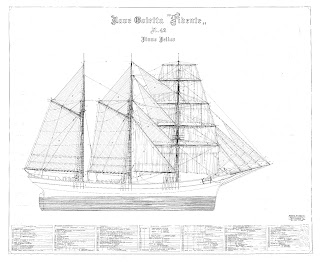
Free Plans of 19th Century Italian Barquentine "Fidente"

free ship plan 19th century Italian barquentine Fidente ship-schooner
Italian "Ship-Schooner" Fidente

From Italian archives come the plans of the “Ship-Schooner” Fidente (Trusting).
In English we would refer to her as a barquentine (alternatively barkentine), which wikipedia defines as "a sailing vessel with three or more masts; with a square rigged foremast and fore-and-aft rigged main, mizzen and any other masts."
I've found a few historical reference to European emigrants arriving in the U.S. aboard a "brig" named Fidente, which as sail-rig terminology can be somewhat loose depending on the person writing it, but nothing solid on her history. If you can track down any more info, please let us know via our contact page.
Even without further documentation, I think Fidente would make a handsome ship model, and would be a good subject if you're not quite ready for a full-rigged ship model.

Wednesday, February 6, 2013

Great Site for Ship Model Plans

A friend of ours in Turkey has a great website for model shipbuilders. He also offers a wide selection of  free ship plans, but where our ship plans are prototype ship plans than can be adopted to model shipbuilding, many of his plans show the ships already adapted to models. Many feature full-size patterns that can be used to cut the keel and bulkheads, and some even feature info on motor installation for radio-controlled operation. This provides a valuable shortcut if you are not familiar with completing this process with a prototype ship plan.

J M Briscoe - Clyde puffer VIC32 moored at Corpach by  Jmb at en.wikipedia
Our all-time favorite of his plans is the Lochinvar Clyde Puffer, a typical Scottish coastal vessel from the early 20th Century. These little tubs just radiate personality. They are so much a part of the U.K. maritime history that a series of novels were written about the exploits of a fictional crew, and later a BBC television series was made based on those books.

This ship is a great subject for modeling because, while the prototype is not very large, it has the very "salty" looks of much larger freighters. With a Clyde Puffer model you can build to a fairly large scale and still have a model that is easily handled.

Another factor that makes this ship a great subject for modelling is that a huge number of these were made during World War II. Classified as "VIC" Victualling Inshore Craft, after the war they were sold off for private use and some still can be found afloat. There are a vast number of images of them available through a simple internet search, so an infinite number of details can be used to make your Clyde Puffer model distinct.

Clyde Puffers also have a very simple, boxy hull shape that makes it easy to plank the hull with sheets of wood veneer, and offers an easy way to learn some of the basic skills that will be needed when it comes to planking more complex hull shapes.

Monday, December 24, 2012

Free Ship Plan: 77-foot North River Schooner

Another interesting free ship plan from Wooden Ship Building by Charles Desmond is the North River Schooner.  The plans are a little rough, as the pages are yellowed and the ink faded, but the missing bulwark lines can be recreated using a coffee stir as a batten. Hold it on edge and bend it to match the existing lines on either side of the missing portion. The wood will give you an accurate curve to trace with a pencil to fill in where the lines are too faint to see.
free ship plan, sail, schooner, New England, Hudson River, North River, vessel
Sail Plan for a 77 foot North River Schooner
free ship plan,section, waterline, sheer, lines, schooner, New England, Hudson River, North River, vessel
Section, Sheer, and Waterline Plans of North River Schooner

This 77-footer is typical of the shoal draft centerboard sailboats used on the Hudson River to haul bulk cargo in the  19th Century. When it was extended, the centerboard acted as a keel, giving the boat stability when tacking to windward, keeping it from "crabbing" - moving sideways rather than forward. When retracted, it allowed the boat to get into shallow waters common along the river, or even be beached for unloading where a harbor wharf wasn't available.

From The Sloops of the Hudson, by By William E. Verplanck and Moses W. Collyer (The Knickerbocker Press 1908):


 The North River schooner was built on somewhat the same plan as the sloop, having a center board, and her bowsprit carried out almost horizontal, and one head-sail, the single jib, attached to a jib-boom, as with the sloop.* (A few of the later schooners carried a flying-jib.---W.E.V.)  She carried not foretopmast. The skippers contented themselves with a maintopsail only and set it like the sloop’s. The foresail was of good size compared with the mainsail and not a mere “ribbon” such as the racing schooner yacht now carries.  The quarter-deck was replaced in the later schooners by a trunk cabin, lighted from the side and end, affording smaller and less pleasant accommodations than those below the quarter-decks of the old packet sloops with their large windows for light and air at the stern.

The schooners were not as good in windward work as the sloop, but with a fair or beam wind they were faster.  The rig, however, soon commended itself for the sloop with her long boom, tall mast, and heavy mainsail was difficult to handle at all times and especially in a blow and required a crew of six men to the schooner’s four. The first of the schooners were converted sloops. From which many of the larger ones were changes to save expense of operation. Late, about 1865 there was built  a new type of schooner for the Hudson which though rigged the same was a wider and shallower boat thus giving her greater carrying capacity and permitting all the cargo to be placed on deck for expedition in loading and unloading. She was quite sharp forward, which—with other good points in her model—made her good sailer.


Friday, November 30, 2012

Ship Plan of an Early British Steamship

Browsing through an old out-of-copyright book The Theory and Design of British Shipbuilding, I found this ship plan for an early British "Screw Steamer," a propeller-driven steamship (as opposed to paddle wheel).

While there is no superstructure detail, this would make a good freelance cargo ship project with deck details pulled from google image searches of early 20th Century British steamships.  This vessel is 320 feet long with a beam of 45 feet and a molded depth of 23 feet.

Clicking on the reduced size image here will bring up the original size document. Just right click and choose "save image as" to download this free ship plan.
free, ship, plan, steamer, steamship, cargo, British, 20th Century, early, draught
320-foot early 20th Century British steamship hull

Wednesday, August 22, 2012

Free Downloadable Ship Plan

The Model Shipwright.com is offering a free downloadable ship plan for the 8,600 ton 1928 French cargo ship Le Mekong.

We're offering a number of plan sheets:

The Profile and Deck Plan, an 83" x 28.5" (size at 200 dpi) sheet showing the details of the ship's decks, superstructure, and deck hardware.
free ship plan, french, cargo ship, cargo vessel

The Lines Plan a 123" x 27.5" (size at 200 dpi) sheet showing the sheer, body, and buttocks plans that are imperative for correctly shaping a model ship hull.
free ship plan, french, le mekong, lines plan, sheer plan, body plan, buttocks plan

Take the TIFF files you download to a print shop that has a oversize-print capability, or you can downsize them in a photo editing program to print out at home. The lines plan is at 1/50 scale, you can easily scale it down to 1/100 and still have a sizable model.

If you'd like a full 15-sheet group of plans already printed, let us know through the contact page, and we'll send a price quote to ship them to you.