statcounter code

Showing posts with label ship models. Show all posts

Wednesday, October 30, 2013

Types of Model Ship Kits

Getting Started in Model Ship Building?


Building a kit is a good way to start before tackling scratch-building


model ship kit, plank on bulkhead, Corel, Ranger
Parts included for the Corel plank-on-bulkhead kit "Ranger."
For the beginning ship modeler, scratch-building a ship model from a plan can be a daunting challenge. A better option for a first project in most cases is to pick from the vast array of ship model kits available today.
There are a number of international, and a few U.S. ship model kit manufacturers, and they are constantly coming out with new offerings that set a ship modeler’s mind racing with possibilities. But, while model ship kit manufacturers are constantly introducing new kits, and adding more detailed models to their lineup, all model ship kits fall into three basic categories, based on hull construction technique: Solid hull; Plank-on-bulkhead; and Plank-on-frame.
For a review of these basic ship model kit types, see our page Types of Ship Model Kits

Wednesday, January 9, 2013

Free Ship Plan: New York Pilot Schooner

Free, New York, pilot, schooner, ship, lines, plan, drawing, sailing, vessel
New York Pilot Schooner lines plan from Desmond's Wooden Ship Building
This New York Pilot Schooner is another plan from Desmond's Wooden Ship Building. These boats share a lot in common with the Baltimore Clipper Schooner in hull shape. Especially in the "drag" of the keel: The ship sits much deeper at the stern than at the bow. One way in which they differ from their ancestor is the bow is much more plumb. Baltimore Clippers tended to have the outward curving bow of a cutter.

This would work up into a nice ship model. Because of the fairly small size of the prototype New York Pilot Boats, model ships can be built to a fairly large scale without resulting in a model too big for display in the average home.

The fore-aft rig of the schooner also simplifies the task of rigging this model ship, but still provides a very salty-looking result. Scratch-building a model of this ship is a good way to develop model shipbuilding skills needed for a larger project, such as a tea clipper of ship of the line, and allows the model builder to see results much more quickly.

Monday, December 24, 2012

Free Ship Plan: 77-foot North River Schooner

Another interesting free ship plan from Wooden Ship Building by Charles Desmond is the North River Schooner.  The plans are a little rough, as the pages are yellowed and the ink faded, but the missing bulwark lines can be recreated using a coffee stir as a batten. Hold it on edge and bend it to match the existing lines on either side of the missing portion. The wood will give you an accurate curve to trace with a pencil to fill in where the lines are too faint to see.
free ship plan, sail, schooner, New England, Hudson River, North River, vessel
Sail Plan for a 77 foot North River Schooner
free ship plan,section, waterline, sheer, lines, schooner, New England, Hudson River, North River, vessel
Section, Sheer, and Waterline Plans of North River Schooner

This 77-footer is typical of the shoal draft centerboard sailboats used on the Hudson River to haul bulk cargo in the  19th Century. When it was extended, the centerboard acted as a keel, giving the boat stability when tacking to windward, keeping it from "crabbing" - moving sideways rather than forward. When retracted, it allowed the boat to get into shallow waters common along the river, or even be beached for unloading where a harbor wharf wasn't available.

From The Sloops of the Hudson, by By William E. Verplanck and Moses W. Collyer (The Knickerbocker Press 1908):


 The North River schooner was built on somewhat the same plan as the sloop, having a center board, and her bowsprit carried out almost horizontal, and one head-sail, the single jib, attached to a jib-boom, as with the sloop.* (A few of the later schooners carried a flying-jib.---W.E.V.)  She carried not foretopmast. The skippers contented themselves with a maintopsail only and set it like the sloop’s. The foresail was of good size compared with the mainsail and not a mere “ribbon” such as the racing schooner yacht now carries.  The quarter-deck was replaced in the later schooners by a trunk cabin, lighted from the side and end, affording smaller and less pleasant accommodations than those below the quarter-decks of the old packet sloops with their large windows for light and air at the stern.

The schooners were not as good in windward work as the sloop, but with a fair or beam wind they were faster.  The rig, however, soon commended itself for the sloop with her long boom, tall mast, and heavy mainsail was difficult to handle at all times and especially in a blow and required a crew of six men to the schooner’s four. The first of the schooners were converted sloops. From which many of the larger ones were changes to save expense of operation. Late, about 1865 there was built  a new type of schooner for the Hudson which though rigged the same was a wider and shallower boat thus giving her greater carrying capacity and permitting all the cargo to be placed on deck for expedition in loading and unloading. She was quite sharp forward, which—with other good points in her model—made her good sailer.


Wednesday, December 5, 2012

Free Ship Plan 19th Century Steam Fishing Trawler


Free ship plan, steam-powered, fishing, trawler, W.E. Redway, Canada, Great Lakes
Steam-powered 19th Century fishing trawler designed by W.E. Redway
These plans, from the University of Washington Freshwater and Marine Image Bank, are of a late 19th Century steam-powered auxiliary fishing trawler of about 80 feet in length, designed by W.E. Redway.

Free ship plan, steam-powered, fishing, trawler, W.E. Redway, Canada, Great Lakes, deck plan
Deck and inboard profile view of 19th Century Great Lakes
steam-powered fishing trawler designed by W.E. Redway
W. E. Redway was a Great Lakes shipbuilder in the late 1800s. 

Born in England, his father was also a shipbuilder. Redway served an apprenticeship in the Chatam dock yard in England, followed by positions in various shipyards "on the northeast coast of England and on the (River) Clyde," according to an 1897 profile in The Globe newspaper in Toronto. The River Clyde, flowing through Scotland's industrial city of Glasgow, was a major shipbuilding center during the Industrial Revolution.

Redway moved to Toronto, Canada in 1886.

Free ship plan, body, sheer, waterline, plan, 19th Century, Great Lakes, Canada, steam-powered, fishing, trawler
Body, Sheer, and waterline plans of 19th Century Great Lakes
steam-powered fishing trawler designed by W.E. Redway
According to The Globe newspaper profile, Redway "up to June 1897, planned and constructed eleven steam vessels. These were the Imperial, the Mayflower, the Primrose, the Garden City, the Mascotte, the Mistassini, the Medora and others. He also framed the Gooderham yachts Cleopatra and Oriole. Hearing of some of his good work, the managers of the Union shipyards at Buffalo sent for Mr. Redway, and he was there second in charge of the building of the steamer Ramapo, being occupied for six months of the year of 1895 at that work."

Friday, November 30, 2012

Ship Plan of an Early British Steamship

Browsing through an old out-of-copyright book The Theory and Design of British Shipbuilding, I found this ship plan for an early British "Screw Steamer," a propeller-driven steamship (as opposed to paddle wheel).

While there is no superstructure detail, this would make a good freelance cargo ship project with deck details pulled from google image searches of early 20th Century British steamships.  This vessel is 320 feet long with a beam of 45 feet and a molded depth of 23 feet.

Clicking on the reduced size image here will bring up the original size document. Just right click and choose "save image as" to download this free ship plan.
free, ship, plan, steamer, steamship, cargo, British, 20th Century, early, draught
320-foot early 20th Century British steamship hull

Sunday, October 7, 2012

New Page: "The Hull: Heart of a Wooden Ship"

Once you've read our page "How to Read a Ship Plan,"  move on to our new page "The Hull: Heart of a Wooden Ship."

free ship plan, sailing, vessel, fishing, schooner, downloadable, Lettie G. Howard, wooden, boat
Fishing schooner Lettie G. Howard lines plan, courtesy Library of Congress
In it we describe all the major components that make up a prototype ship's hull, from keel to deck beams, and explain their function. 

We also provide a bunch of free ship plans for New England fishing schooners Ernestina and Lettie G. Howard pulled from the collection of the Library of Congress.

Friday, September 21, 2012

An Unexpected Trip Back to Childhood Model Ship Building


It's time for a trip back to childhood.

Back in the early 1960s, my grade school library in Flint, Michigan wasn't the most up-to-date. It had one book on model boats. It was Boys' Book of Model Boats by Raymond Francis Yates, published in 1920 by The Century Co.
Free book, model shipbuilding, ship model, building, model boats
Boys' Book of Model Boats by Raymond Francis Yates

I checked that book out week after week, and read it front-to-back, back-to-front, middle-to-ends and any other way possible. My favorite part was (being a child in a state surrounded by the Great Lakes) the chapter on building an electric lake freighter.

I didn't have access to a saw, but I found some 2x4s in the garage that had been cut with stake-like pointed ends. I stacked them, nailed them together, and found other bits of wood from which to make the freighter superstructure and funnel. I even found some small nails and string to model the stanchions and railings surrounding the bow and stern on real freighters I'd seen.

Excited to launch my new "scale" model of an actual lake freighter, I insisted we take the two-foot long chunk of lumber with nails sticking out of it with us on our trip to our summer cottage. My mother, however, drew the line at letting me carry a potentially dangerous weapon on my lap during the two-hour car ride. She made me put it behind the seats in the cargo compartment of our Buick station wagon.

When we arrived, I immediately changed into my swimming trunks, and insisted we go swimming. I carried my model carefully down the trail through the woods that led to the lake. Casting aside towel and sandals, I dashed into the cold water almost to my waist, and carefully set my lake freighter model in the water.

Imagining a band playing a John Philip Sousa march appropriate for the launching of such an impressive vessel, I carefully let go of the model.

And it promptly capsized.

I never did get that darn thing to float right, but I kept it on a shelf in my room for years.

I had not thought of that first attempt at ship modeling for years. Then, while scouring the internet for ship modeling info, I found a digitized copy of none other than Boys' Book of Model Boats!

Reading through it brought all those memories back, so I'm posting a PDF copy of the now out-of-copyright and I'm sure out-of-print book here. I hope it brings back as many of your memories of first attempts at building a ship model as it did mine.

Click on the book title link at the top of the post and enjoy!

Saturday, September 1, 2012

Plans for a U.S. Coast Guard Cutter


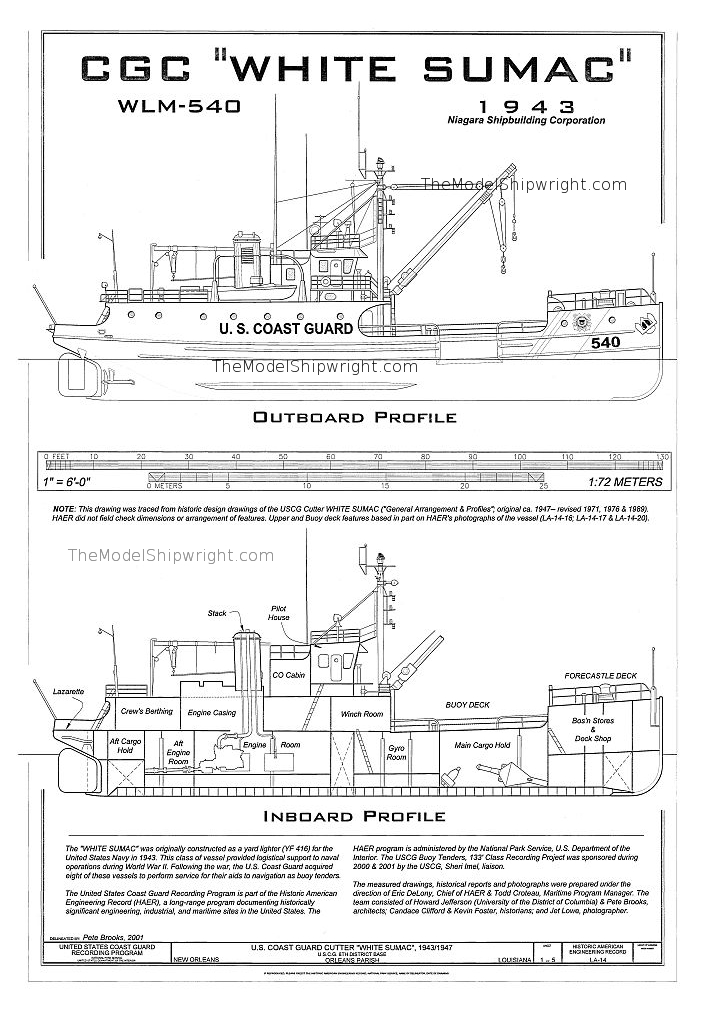
By request, here are free ship plans for a World War II era ex-Navy 133-foot United States Coast Guard Cutter.
Free Ship Plan coast guard cutter The Model Shipwright TheModelShipwright.com
Coast Guard Cutter White Sumac

 In addition to the plans presented here, we also have a number of detail plans, including one showing the difference between when the vessel was commissioned in the U.S. Navy and its service as a Coast Guard Cutter.

The U.S. Coast Guard cutter White Sumac was originally constructed as a yard lighter (YF416) for the United States Navy in 1943. This class of vessel provided logistical support to naval operations during World War II. Following the War, the Coast Guard acquired eight of these vessels to use as buoy tenders. The vessel was documented as part of a National Park Service program that documents historically significant engineering, industrial, and maritime sites in the U.S. These plans are maintained by the Library of Congress.

The Model Shipwright offers these ship plans to members FREE as high-resoultion TIFF files, or, we can send you prints of the plans for $10 per 24" x 36" sheet, plus postage. For more information, use our Contact Page to let us know of your interest.


Free Ship Plan from The Model Shipwright TheModelShipwright.com
U.S. Coast Guard Cutter White Sumac Deck Plan

Free Ship Plan from The Model Shipwright TheModelShipwright.com
U.S. Coast Guard Cutter White Sumac Sections Plan

Free Ship Plan from The Model Shipwright TheModelShipwright.com
U.S. Coast Guard Cutter White Sumac Body Plan

Free Ship Plan from The Model Shipwright TheModelShipwright.com
U.S. Coast Guard Cutter White Sumac Shell Plating Plan

Tuesday, August 28, 2012

What Are You Looking For?


Model ship building is more than a hobby, it's a quest for knowledge.

Model ship builders are always researching; a current project or a future project, there is always research to be done.

And, there are innumerable websites with information for model ship builders.  But "Search Engine Optimization," the skill of making a website rank high on internet search results, often leads to search results where sites that have the least amount of USEABLE ship modeling information (but whose creators know what Google is looking for) show up with the highest rank.

The converse is also, unfortunately, true: many of the best ship model building resources are obscure sites created for academics that already know of them, that are not optimized for internet, and are hard to find.

Search Engine Optimization has created a situation where the greatest trove of information in the known universe is like a superhighway so littered by billboards a user can't see the sign to the exit they need.

That's why we started The Model Shipwright. We are ship modelers who have already spent countless hours and hours pouring through low-ranking web pages looking for high-quality sources of ship plans, maritime history and other info for our shipbuilding projects. Now we want to bring those public-domain resources together in a place that's easy for model ship builders to find.

But, the public domain sources are so vast we can't post them all. We need to know what you want most. Use our Contact Page to give us your "wish list" of ship modeling information. 

Keep in mind we don't want to break copyright law, so we can't post plans from kits by existing manufacturers, or from recently-published books. It's also hard to find ship plans for a specific vessel. It's often much easier to find data on a ship type, along with information on how a specific ship differed from its sister ships.

Our own Search Engine Optimization skills can make this site easy to find, but only our members can make it useful. Let us help you find what you're looking for!

Wednesday, August 22, 2012

Free Downloadable Ship Plan

The Model Shipwright.com is offering a free downloadable ship plan for the 8,600 ton 1928 French cargo ship Le Mekong.

We're offering a number of plan sheets:

The Profile and Deck Plan, an 83" x 28.5" (size at 200 dpi) sheet showing the details of the ship's decks, superstructure, and deck hardware.
free ship plan, french, cargo ship, cargo vessel

The Lines Plan a 123" x 27.5" (size at 200 dpi) sheet showing the sheer, body, and buttocks plans that are imperative for correctly shaping a model ship hull.
free ship plan, french, le mekong, lines plan, sheer plan, body plan, buttocks plan

Take the TIFF files you download to a print shop that has a oversize-print capability, or you can downsize them in a photo editing program to print out at home. The lines plan is at 1/50 scale, you can easily scale it down to 1/100 and still have a sizable model.

If you'd like a full 15-sheet group of plans already printed, let us know through the contact page, and we'll send a price quote to ship them to you.

Monday, August 13, 2012

Free Book Download!


There's nothing like going back to the source material to learn about a subject, and TheModelShipwright.com is offering a free PDF download of The Elements of Wood Ship Construction, by William Henry Curtis, published in 1919 for the Education and Training Section of the Emergency Fleet Corporation. 
free ship plans, build, ship models, model ships, boat models, model boats
Click here to visitTheModelShipwright.com

"It is intended for the use of carpenters and others, who, though skilled in their work, lack the detail knowledge of ships necessary for the efficient performance of their work in the yard," according to the preface.

Beginning with Keels, stems and stern posts, the book moves through frames, inboard hull details, deck details, and explains planking, erections and joiner work with copious illustration.

When the U.S. entered World War I, the United States Shipping Board's Emergency Fleet Corporation realized the need for a quickly-built supply of cargo ships that could combat the Germans' uboat fleet predations on shipping by simply building them faster than they could sink them.
free ship plans, wood ship, ship model, model ship, boat model, model boat
Illustration from The Elements
of Wood Ship Construction

With a large number of shipyards along the East Coast still building wooden boats, the EFC came up with a series of designs that could take advantage of the available technology to crank out wooden steamships. But there were not a sufficient number of trained shipwrights, so the EFC also developed a number of books to acclimate non-nautical carpenters, plumbers, and pipe-fitters to the specific needs of the shipbuilding industry.

The original books are long out of print, and usually can only be found in academic libraries, but Google and archive.org have digitized some of them so the knowledge they contain can still be available.  They are an invaluable resource to the model shipwright who wants to understand not only how prototype wooden ships were built, but why they were built that way.

Sunday, August 12, 2012

Confused By All Those Lines on a Ship Plan?

free ship plan Auxiliary Fishing Schooner Evelina M. Goulart sheer plan body plan half-breadth plan water lines section lines buttock lines sheer line rabbet line
Auxiliary Fishing Schooner Evelina M. Goulart, plan courtesy of The Historic American Engineering Record Maritime Recording Program, National Park Service, Delineated by Jairo Umana, 1999
Does this look like a spaghetti bowl of lines to you? Read our page How to Read a Ship Plan

Tuesday, August 7, 2012

"I Want to Build a Model Ship"


Sitting in a quaint seaside restaurant, you look up, and on a shelf above sits a beautiful, highly-detailed, fully-rigged model of a clipper ship, sails bent to an imaginary breeze as it rushes toward port, its cargo holds heavy with crates of tea from China. Your first thought is:

"I want to build a ship model just like that."

Then, you quickly think: "But I could never build a model ship that detailed."

Yes, you can.

And in this blog, I will show you how.

Ship modeling is a wonderful hobby to take your mind off the daily stresses, while at the same time exercising your mind by learning about the rich and varied history of maritime transportation.

Illustration from Chapelle's
History of American Sailing Ships
The best way to get started in ship modeling is to think about what you want to build. That three-masted clipper with a maze of rigging that piqued your interest is certain to make your mind race with possibilities, but it's also a very complicated project that will take an extraordinary amount of time to finish. It's probably a better idea to set your sights a little lower for your first project.

There are hundreds of types of ships, and thousands of variations of those types. There are a number of good books out there to help you sort through them. One of the best authors of these books (in regards to American sailing ships) is Howard Irving Chapelle.

A noted naval architect, Chapelle also served as curator of maritime history at the Smithsonian Institution. During the depression he worked on the Historic American Merchant Marine Survey, which documented the quickly disappearing U.S. merchant sailing fleet. Most of his books can be found used, or in libraries. The three most valuable at the beginning of your search are:

  • American Small Sailing Craft ISBN 0393031438
  • History of American Sailing Ships ISBN 0517023326
  • History of the American Sailing Navy: The Ships and Their Development ISBN 0517004879
American Small Sailing Craft is mainly limited to boats of 40 feet or less (as one might infer from the title), and details the development of everything from rowboats to fairly large fishing vessels. The History of American Sailing Ships covers the development of the bigger ships not covered in the first volume, including an overview of naval vessels. History of the American Sailing Navy delves into much more detail of the development of naval vessels, and is probably only necessary if you decide after reading the first two that you MUST build a ship of war.

Chapelle's writing at first may seem dense with the unfamiliar arcana of wooden ships, but there is a secret to using these books as source material for model ship building: Start by just leafing through and looking at the illustrations! Put a bookmark at the illustration of each ship that piques your interest. Then, go back through and decide which you like the most. Once you have settled on a starting point, find where that ship is mentioned in the text. It should be within a page or two of the illustration. If all else fails, you can always resort to the index.

The great thing about Chapelle's writing is that you can pick any page of these books to start reading, and not be completely lost. You may find he references an type of boat from earlier in the book, but you can always go back to that one if you don't understand the comparison. Following this method, you will begin to develop an idea about what kind of ship model you would like to build, whether it's a Chesapeake Bay Skipjack, a Grand Banks fishing schooner, or a navy man-o-war. Just remember, your first model is not going to be your best, so you want to start with a project that's O.K. to learn on, and maybe make a few mistakes.

Once you have a pretty good idea what model ship you want to build, you can go online to see if it's available as a ship model kit, or if you would have tackle building from scratch. The good news is, there are a lot of different ship model kits out there to choose from. The bad news is, they can be pricey.

Next time: an overview of available ship model kits!