
How To Build First-Class Model Ships From Kits or From Ship Plans
statcounter code
Tuesday, August 28, 2012
What Are You Looking For?
Model ship building is more than a hobby, it's a quest for knowledge.
Model ship builders are always researching; a current project or a future project, there is always research to be done.
And, there are innumerable websites with information for model ship builders. But "Search Engine Optimization," the skill of making a website rank high on internet search results, often leads to search results where sites that have the least amount of USEABLE ship modeling information (but whose creators know what Google is looking for) show up with the highest rank.
The converse is also, unfortunately, true: many of the best ship model building resources are obscure sites created for academics that already know of them, that are not optimized for internet, and are hard to find.
Search Engine Optimization has created a situation where the greatest trove of information in the known universe is like a superhighway so littered by billboards a user can't see the sign to the exit they need.
That's why we started The Model Shipwright. We are ship modelers who have already spent countless hours and hours pouring through low-ranking web pages looking for high-quality sources of ship plans, maritime history and other info for our shipbuilding projects. Now we want to bring those public-domain resources together in a place that's easy for model ship builders to find.
But, the public domain sources are so vast we can't post them all. We need to know what you want most. Use our Contact Page to give us your "wish list" of ship modeling information.
Keep in mind we don't want to break copyright law, so we can't post plans from kits by existing manufacturers, or from recently-published books. It's also hard to find ship plans for a specific vessel. It's often much easier to find data on a ship type, along with information on how a specific ship differed from its sister ships.
Our own Search Engine Optimization skills can make this site easy to find, but only our members can make it useful. Let us help you find what you're looking for!

Wednesday, August 22, 2012
Free Downloadable Ship Plan
The Model Shipwright.com is offering a free downloadable ship plan for the 8,600 ton 1928 French cargo ship Le Mekong.
We're offering a number of plan sheets:
The Profile and Deck Plan, an 83" x 28.5" (size at 200 dpi) sheet showing the details of the ship's decks, superstructure, and deck hardware.
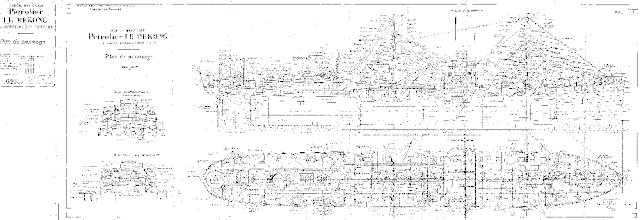
The Lines Plan a 123" x 27.5" (size at 200 dpi) sheet showing the sheer, body, and buttocks plans that are imperative for correctly shaping a model ship hull.

Take the TIFF files you download to a print shop that has a oversize-print capability, or you can downsize them in a photo editing program to print out at home. The lines plan is at 1/50 scale, you can easily scale it down to 1/100 and still have a sizable model.
If you'd like a full 15-sheet group of plans already printed, let us know through the contact page, and we'll send a price quote to ship them to you.
We're offering a number of plan sheets:
The Profile and Deck Plan, an 83" x 28.5" (size at 200 dpi) sheet showing the details of the ship's decks, superstructure, and deck hardware.

The Lines Plan a 123" x 27.5" (size at 200 dpi) sheet showing the sheer, body, and buttocks plans that are imperative for correctly shaping a model ship hull.

Take the TIFF files you download to a print shop that has a oversize-print capability, or you can downsize them in a photo editing program to print out at home. The lines plan is at 1/50 scale, you can easily scale it down to 1/100 and still have a sizable model.
If you'd like a full 15-sheet group of plans already printed, let us know through the contact page, and we'll send a price quote to ship them to you.
Monday, August 13, 2012
Free Book Download!
There's nothing like going back to the source material to learn about a subject, and TheModelShipwright.com is offering a free PDF download of The Elements of Wood Ship Construction, by William Henry Curtis, published in 1919 for the Education and Training Section of the Emergency Fleet Corporation.
 |
| Click here to visitTheModelShipwright.com |
"It is intended for the use of carpenters and others, who, though skilled in their work, lack the detail knowledge of ships necessary for the efficient performance of their work in the yard," according to the preface.
Beginning with Keels, stems and stern posts, the book moves through frames, inboard hull details, deck details, and explains planking, erections and joiner work with copious illustration.
When the U.S. entered World War I, the United States Shipping Board's Emergency Fleet Corporation realized the need for a quickly-built supply of cargo ships that could combat the Germans' uboat fleet predations on shipping by simply building them faster than they could sink them.
 |
| Illustration from The Elements of Wood Ship Construction |
With a large number of shipyards along the East Coast still building wooden boats, the EFC came up with a series of designs that could take advantage of the available technology to crank out wooden steamships. But there were not a sufficient number of trained shipwrights, so the EFC also developed a number of books to acclimate non-nautical carpenters, plumbers, and pipe-fitters to the specific needs of the shipbuilding industry.
The original books are long out of print, and usually can only be found in academic libraries, but Google and archive.org have digitized some of them so the knowledge they contain can still be available. They are an invaluable resource to the model shipwright who wants to understand not only how prototype wooden ships were built, but why they were built that way.
Subscribe to:
Posts (Atom)